October 15, 2026
WPC Cladding vs. Fiber Cement Wall Panels Selection: Thermal Insulation, Weight, and Installation Cost Trade-Offs
1. Introduction: The Facade Decision That Shapes Budget and Performance
I have been specifying exterior cladding systems for commercial and residential projects for over a decade, and I can tell you that the most consequential decision in facade procurement is almost never made with the right data on the table. The architect specifies a look. The contractor quotes a price. And somewhere between the two, the trade-offs in thermal performance, weight, and installation cost get lost in the shuffle.
Here is what that looks like in practice. A developer is specifying cladding for a 12,000 m² commercial facade. WPC cladding comes in at $160–380/m² fully installed. Fiber cement comes in at a comparable or slightly lower range depending on the profile and finish. On paper, the two options look financially similar. But the weight difference is 5 to 10 times, the installation labor premium for fiber cement runs 40–60% of the total project budget, and the long-term maintenance profiles are completely different.
The global cladding market continues to expand, and the choice between WPC and fiber cement is one of the most frequently debated specification decisions in facade design. WPC offers a natural wood aesthetic with zero maintenance and significantly lower weight. Fiber cement offers non-combustible fire performance, dimensional stability, and a 40–60 year service life.
This guide breaks down the three variables that matter most for the procurement decision — thermal insulation, weight, and installation cost — with real performance data, and the selection framework that matches material to project.
2. How Each Material Actually Works
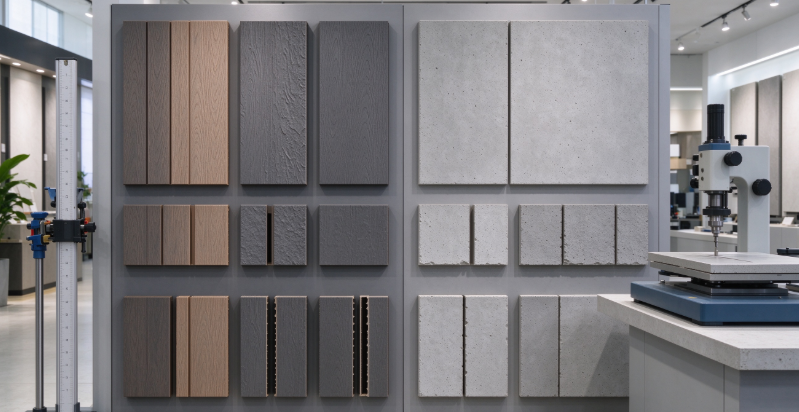
WPC (Wood-Plastic Composite) cladding is a co-extruded composite made from wood fibers (typically 55–60%) blended with high-density polyethylene (HDPE, 40–45%) and chemical additives. The boards are typically co-extruded with a protective polymer cap layer over a composite core. Standard profiles include solid and hollow-core configurations, with interlocking edges for concealed fixing. The material is UV-resistant, moisture-resistant, and does not require painting or sealing. A typical 14.5mm thick board with 153mm usable width weighs approximately 10.72 kg/m² and achieves a thermal conductivity of 0.20 W/(m·K) .
Fiber cement cladding is made from a mixture of Portland cement, sand, cellulose fibers, and water, formed into panels under high pressure. The material is autoclaved or air-cured, resulting in a dense, dimensionally stable panel. Fiber cement is inherently non-combustible, resistant to rot and termites, and accepts paint or a factory-applied finish. A typical 8mm fiber cement panel weighs 10.2 kg/m², and an 11mm panel weighs 14.4 kg/m². The thermal conductivity is approximately 0.23 W/(m·K) .
The fundamental difference is the binder system. WPC uses a thermoplastic polymer matrix; fiber cement uses a cementitious matrix. This difference cascades into every performance metric that follows — thermal conductivity, weight, fire resistance, and installation method.
3. Thermal Insulation: The Conductivity Gap and What It Means in Practice
The thermal conductivity of WPC and fiber cement cladding is similar, and neither material is a meaningful insulator on its own. The difference is in the direction of the numbers and the implications for wall system design.
WPC thermal conductivity ranges from 0.0912 to 0.3453 W/(m·K) depending on the specific formulation and density. Research on locally manufactured WPCs found values of 0.0912, 0.1174, 0.3453, and 0.3078 W/(m·K) for different WPC types. A typical commercial WPC cladding achieves approximately 0.20 W/(m·K) .
Fiber cement thermal conductivity is typically in the range of 0.23 to 0.5 W/(m·K) depending on the density and composition. One reference value places fiber cement board at 0.5 W/(m·K) for an 8mm board with a thermal resistance of 0.016 m²K/W. Another manufacturer datasheet specifies λ10,tr = 0.23 W/(m·K) with a thermal resistance of 0.035 m²K/W .
Thermal Parameter | WPC Cladding | Fiber Cement Cladding |
Thermal conductivity range | 0.09–0.35 W/(m·K) | 0.23–0.5 W/(m·K) |
Typical commercial value | 0.20 W/(m·K) | 0.23–0.29 W/(m·K) |
Thermal resistance (typical panel) | ~0.07 m²K/W | 0.016–0.035 m²K/W |
R-value contribution | Minimal | Minimal |
Sources: OUCI WPC thermal study, BIMobject WEO Essential, Hardie Architectural Panel datasheet
The practical implication is that neither material provides meaningful thermal insulation. The 14.5mm WPC board at 0.20 W/(m·K) contributes an R-value of approximately 0.07 m²K/W. The 8mm fiber cement board at 0.5 W/(m·K) contributes approximately 0.016 m²K/W. Both are negligible compared to the R-value of the wall assembly. For reference, an R-value of up to 3.44 can be achieved for a fiber cement wall system when combined with cavity construction and suitable insulation — but that R-value comes from the insulation, not the cladding .
WPC's slightly lower thermal conductivity is an advantage for reducing heat transfer through the cladding itself, but the effect is small. The more significant thermal consideration is solar absorption. Research comparing MgO and fiber cement boards found that fiber cement boards have greater solar absorption and are therefore more inclined to heating, and they typically have lower hygrothermal behavior than alternative board materials. A WPC cladding with a reflective cap layer absorbs less solar energy and stays cooler on the surface .
For projects where thermal performance is the primary concern, neither material is the answer. The wall assembly — insulation, cavity, and air barrier — determines thermal performance. The cladding selection is driven by weight, installation cost, fire performance, and aesthetics.
4. Weight: The Structural Load That Determines Subframe Cost
The weight difference between WPC and fiber cement cladding is substantial and has direct consequences for structural design, subframe requirements, and installation logistics.
WPC cladding weight is approximately 10.72 kg/m² for a standard 14.5mm co-extruded board. The lightweight construction is a function of the polymer matrix and the hollow-core or foamed profiles used in many WPC cladding systems. For a 1,000 m² facade, the total cladding weight is approximately 10,720 kg .
Fiber cement cladding weight ranges from 10.2 kg/m² for an 8mm panel to 14.4 kg/m² for an 11mm panel. Heavier configurations (12mm and above) reach 22.8 kg/m². For a 1,000 m² facade, the total cladding weight ranges from 10,200 kg for 8mm panels to 22,800 kg for 12mm panels .
Weight Parameter | WPC Cladding | Fiber Cement Cladding |
Typical panel weight | 10.72 kg/m² (14.5mm) | 10.2–14.4 kg/m² (8–11mm) |
Heavy-duty configuration | 14.75 kg/m² | 22.8 kg/m² (12mm) |
Weight per 1,000 m² facade | 10,720 kg | 10,200–22,800 kg |
Handling requirement | One-person lift | Two-person lift (per manufacturer guidelines) |
Sources: BIMobject WEO Essential, James Hardie technical data, EQUITONE product data
The weight difference is most pronounced at the heavy-duty end of the fiber cement range. An 11mm fiber cement panel at 14.4 kg/m² is 34% heavier than a standard WPC board. A 12mm panel at 22.8 kg/m² is 113% heavier — more than twice the weight of WPC.
This weight difference has three practical consequences.
Subframe requirements. Fiber cement's higher weight demands a more robust subframe — heavier gauge battens, closer fixing centers, and more frequent support brackets. The subframe cost difference can be 15–25% higher for fiber cement compared to WPC. In projects where the structural engineer is already working close to load limits, the additional dead load from fiber cement may require reinforcing the primary structure.
Installation labor. Fiber cement panels are heavy and require two-person crews for safe handling. Cutting requires diamond blades and OSHA-compliant dust extraction for silica control. The combination of heavier panels and specialized cutting tools increases the installation labor premium substantially .
Freight and logistics. The weight difference affects shipping costs, crane requirements for multi-story facades, and the number of panels that can be handled per truckload. For projects where freight is a significant cost component, WPC's lighter weight provides a measurable logistics advantage.
5. Installation Cost: Labor, Tools, and the Hidden Premium
The installation cost comparison is where the selection decision gets financially real. The material cost difference between WPC and fiber cement is modest; the installation cost difference is substantial.
WPC installation labor runs approximately $3–6 per square foot ($32–65/m²). The boards are lightweight, interlocking, and installed with stainless steel screws on wooden or metal battens. The concealed fixing system is designed for quick installation, and the material can be cut with standard woodworking tools. Professional installation adds $60–130/m²** to the material cost, bringing the total installed cost to **$160–380/m² .
Fiber cement installation labor runs $4–9 per square foot ($43–97/m²), with some markets reporting $2.20–5.00/sq ft for standard installations and $3.00–5.50/sq ft in high-cost metropolitan areas. The panels are heavy, require two-person crews, and must be cut with diamond blades under dust extraction. Field-cut edges must be primed and sealed to prevent moisture absorption. The total installed cost for fiber cement cladding ranges from $6–17 per square foot ($65–183/m²) depending on the profile and market .
Cost Category | WPC Cladding | Fiber Cement Cladding |
Material cost | $100–250/m² | $30–80/m² (material only) |
Installation labor | $60–130/m² | $43–97/m² |
Total installed cost | $160–380/m² | $65–183/m² |
Labor as % of total | 35–40% | 45–60% |
Cutting tools | Standard woodworking | Diamond blades + dust extraction |
Crew size | One person | Two persons |
Sources: Necowood TCO analysis, HSCS pricing guide, Amazing Exteriors, Colorado Siding
The numbers tell an interesting story. Fiber cement has a lower material cost than WPC in many markets — $30–80/m² versus $100–250/m². But the installation labor is higher, and the total installed cost range for fiber cement ($65–183/m²) is actually lower than the WPC range ($160–380/m²) at the entry level.
This apparent contradiction reflects the market positioning of the two products. WPC cladding is a premium product positioned on aesthetics and zero maintenance. Fiber cement is a volume product positioned on durability and fire performance. The WPC material cost reflects the co-extrusion process and the UV-stabilized cap layer. The fiber cement material cost reflects the commodity nature of cement and sand.
For B2B buyers, the correct comparison is total installed cost per square meter for the specific project, not the material cost alone. A project that requires a high-end WPC finish with a complex subframe may cost $380/m² installed. A project using a basic fiber cement panel on a simple wall may cost $65/m² installed. The decision depends on what the project actually requires.
6. Fire Performance: The Compliance Floor That Eliminates Options
Fire performance is where the two materials diverge most sharply, and where the specification decision becomes a compliance requirement rather than a preference.
Fiber cement cladding is classified as A2-s1, d0 under EN 13501-1 — the second-highest fire rating available for building materials, indicating limited combustibility and very low smoke production. It is also classified as non-combustible when tested to ASTM E136. This rating makes fiber cement suitable for buildings requiring enhanced fire performance, including high-rise construction, and it complies with bushfire construction requirements up to BAL-40 with fire ratings of up to 60 minutes when used in certified wall systems .
WPC cladding fire performance is variable. Standard WPC achieves Euroclass E — the lowest acceptable fire rating for building materials, indicating a material that can contribute to fire spread. Some higher-performance WPC products achieve Euroclass B-s2, d0, but these are premium formulations with fire-retardant additives and are not representative of the standard product range .
Fire Parameter | WPC Cladding | Fiber Cement Cladding |
EN 13501-1 classification | Euroclass E (standard); B-s2,d0 (premium) | A2-s1, d0 |
ASTM E136 non-combustibility | No | Yes |
Bushfire compliance | Not rated | BAL-40 (in certified systems) |
Fire resistance rating | Not rated | Up to 60 minutes (certified systems) |
Suitable for high-rise | Limited — check local code | Yes |
Sources: BIMobject WEO Essential, NBS Source Class B WPC, HardiePlank datasheet, Big River Group
The compliance implication is straightforward. For any project where the building code requires non-combustible cladding — high-rise residential, commercial buildings above a certain height, buildings in bushfire-prone zones, or projects seeking enhanced insurance ratings — fiber cement is the only compliant option. WPC cladding cannot meet the A2-s1, d0 classification that these applications require, regardless of the manufacturer or the formulation.
For low-rise residential and commercial buildings where combustible cladding is permitted, WPC remains a viable option. But the fire rating must be verified against the local building code, and the specification must be explicit about the Euroclass rating of the specific product being supplied.
7. Maintenance and Total Cost of Ownership Over 25 Years
The maintenance profile and total cost of ownership over a 25-year horizon is where the WPC value proposition becomes clearest — and where the fiber cement repainting cycle becomes a significant budget item.
WPC cladding requires essentially zero maintenance. Co-extruded WPC cladding requires no painting, no sealing, and no staining. Annual maintenance cost is approximately $0–5/m²**, limited to occasional washing with water to remove surface dirt. A 25-year TCO analysis found that WPC delivers **$0 maintenance cost over 25 years and a total lifecycle cost of $160–380/m² — the lowest among premium facade materials. WPC surpasses wood and fiber cement in ROI breakeven by year 5 .
Fiber cement cladding requires repainting every 10 to 15 years. The first repaint is typically required around year 8 to 12, with at least two to three full repaint cycles across a 30-year span. The cost to professionally repaint fiber cement starts around $2.50 per square foot ($27/m²), including labor and materials. Over 25 years, the maintenance cost for fiber cement ranges from $200–300/m² in repainting alone .
Maintenance Parameter | WPC Cladding | Fiber Cement Cladding |
Annual maintenance cost | $0–5/m² | $5–12/m² (averaged) |
Repainting interval | Never | Every 10–15 years |
Repainting cost per cycle | $0 | $27/m² |
25-year maintenance cost | $0–125/m² | $200–300/m² |
Service life | 20–30 years | 40–60+ years |
25-year TCO | $160–380/m² | $265–483/m² |
Sources: Yida Wood WPC maintenance data, Necowood 25-year TCO, Nichiha lifecycle, Reuther Material
The total cost of ownership calculation over 25 years favors WPC. The fiber cement panel itself may last longer — 40 to 60 years versus 20 to 30 years for WPC — but the repainting requirement over the first 25 years adds $200–300/m² to the lifecycle cost. The WPC cladding's higher upfront cost is offset by zero maintenance. For projects with a 25-year ownership horizon, WPC delivers a lower total cost of ownership. For projects with a 50-year horizon, fiber cement's longer service life and the amortization of repainting costs may shift the balance.
8. Head-to-Head: Complete Comparison Table
Parameter | WPC Cladding | Fiber Cement Cladding |
Material composition | 55–60% wood fiber + 40–45% HDPE | Cement, sand, cellulose fibers |
Thermal conductivity | 0.20 W/(m·K) | 0.23–0.5 W/(m·K) |
Weight per m² | 10.72 kg (14.5mm) | 10.2–22.8 kg (8–12mm) |
Fire rating (EN 13501-1) | Euroclass E (standard); B (premium) | A2-s1, d0 |
Non-combustible | No | Yes |
Material cost | $100–250/m² | $30–80/m² |
Installation labor | $60–130/m² | $43–97/m² |
Total installed cost | $160–380/m² | $65–183/m² |
Installation crew | One person | Two persons |
Cutting tools | Standard woodworking | Diamond blades + dust extraction |
Maintenance | Zero — no painting | Repaint every 10–15 years |
25-year maintenance cost | $0 | $200–300/m² |
Service life | 20–30 years | 40–60+ years |
25-year TCO | $160–380/m² | $265–483/m² |
Bushfire compliance | Not rated | BAL-40 (certified systems) |
Best for | Low-rise, aesthetic priority, zero maintenance | High-rise, fire zones, long-life projects |
9. The Selection Matrix: Matching Material to Project
The selection decision is determined by four variables: building height and fire code, service life requirement, maintenance capability, and budget. The matrix below maps the decision.
Project Scenario | Recommended Material | Rationale |
Low-rise residential, aesthetic priority | WPC | Zero maintenance, natural wood look, lighter subframe |
High-rise commercial (>4 stories) | Fiber cement | A2-s1, d0 fire rating required by code |
Bushfire-prone zone (BAL-40) | Fiber cement | Only compliant option in certified systems |
Coastal, salt spray exposure | WPC | Zero moisture absorption, no corrosion risk |
50-year institutional building | Fiber cement | Longer service life amortizes repainting cost |
20–25 year commercial project | WPC | Lower 25-year TCO, zero maintenance |
Budget-constrained volume housing | Fiber cement | Lower material cost, simpler profile |
Premium hospitality facade | WPC | Aesthetic differentiation, low maintenance |
Insurance-sensitive industrial | Fiber cement | Non-combustible rating reduces premiums |
10. Case Study: A 12,000 m² Commercial Facade
The most instructive case study for the WPC versus fiber cement decision comes from a commercial facade analysis using 2026 market data.
The project. A 12,000 m² commercial facade was evaluated for three material options: WPC, aluminum composite panel (ACP), and natural stone. The analysis compared fully installed costs and 25-year total cost of ownership.
The WPC option. Fully installed cost of $160–380/m²**, with zero maintenance cost over 25 years. The 25-year TCO was **$160–380/m². Weight was 9–10.72 kg/m², requiring minimal subframe reinforcement. The ROI breakeven versus wood and fiber cement was reached by year 5 .
The comparison. Aluminum composite panel (ACP) was fully installed at $350–600/m²** with a 25-year maintenance cost of $200–300/m² for repainting at year 15, resulting in a 25-year TCO of $550–1,250/m². Natural stone was fully installed at **$800–1,850/m² with a 25-year TCO of $960–2,150/m² .
The fiber cement comparison. Fiber cement was not included in the original TCO analysis, but the data from separate sources allows a comparison. Fiber cement fully installed at $65–183/m²** with a 25-year maintenance cost of **$200–300/m² for two repainting cycles results in a 25-year TCO of $265–483/m² — slightly higher than WPC at the entry level, but lower at the premium end.
The lesson for B2B buyers. The 12,000 m² facade case demonstrates that the 25-year TCO comparison between WPC and fiber cement depends on the specification tier. At the entry level, fiber cement's lower installed cost partially offsets the repainting requirement, and the two materials are roughly comparable. At the premium level, WPC's higher installed cost is offset by zero maintenance, and WPC delivers a lower 25-year TCO. The decision must be made on a project-specific basis, not on a generic material preference.
11. Practical Sourcing Framework for B2B Buyers
If you are specifying cladding for a project, here is the framework I recommend.
Step 1: Determine the fire code requirement first. This is the gating decision. If the building code requires A2-s1, d0 or non-combustible cladding — high-rise, bushfire zone, or enhanced insurance — fiber cement is the only compliant option. No other variable matters if the material cannot be legally installed.
Step 2: Define the service life and ownership horizon. For a 25-year ownership horizon, WPC's zero maintenance and lower 25-year TCO make it the more cost-effective choice. For a 50-year institutional building, fiber cement's longer service life and the amortization of repainting costs may shift the balance.
Step 3: Assess the weight and subframe requirements. Fiber cement is heavier than WPC, particularly at the 11mm and 12mm thicknesses. If the structural engineer is working close to load limits, WPC's lighter weight reduces the subframe cost and may eliminate the need for structural reinforcement.
Step 4: Calculate the installed cost, not the material cost. The material cost comparison is misleading. Fiber cement has lower material cost but higher installation labor. WPC has higher material cost but lower installation labor. The correct comparison is total installed cost per square meter for the specific project wall assembly.
Step 5: Factor in the maintenance commitment. Fiber cement requires repainting every 10–15 years at approximately $27/m² per cycle. Over 25 years, this adds $200–300/m² to the lifecycle cost. WPC requires no painting. If the project has no maintenance budget or the facade is difficult to access, WPC is the practical choice.
Step 6: Verify the fire rating of the specific product. Do not assume that all fiber cement is A2-s1, d0 or that all WPC is Euroclass E. Verify the specific product datasheet and the EN 13501-1 classification. For WPC, request the Euroclass rating and confirm it meets the local building code.
Step 7: Request a sample and test the installation method. For WPC, verify the interlocking system and the concealed fixing method. For fiber cement, verify the cutting requirements and the edge sealing procedure. A trial installation on a mock-up panel will reveal installation challenges before the full facade is specified.
12. Frequently Asked Questions
Q: Which material has better thermal insulation — WPC or fiber cement?
Neither material provides meaningful thermal insulation. WPC has a slightly lower thermal conductivity (0.20 W/(m·K)) compared to fiber cement (0.23–0.5 W/(m·K)), but both contribute minimal R-value to the wall assembly. Thermal performance is determined by the insulation layer behind the cladding, not the cladding itself. Fiber cement has higher solar absorption, which can increase surface temperature.
Q: Which is heavier — WPC or fiber cement cladding?
Fiber cement is heavier than WPC, particularly at thicker profiles. A standard 8mm fiber cement panel weighs 10.2 kg/m², compared to 10.72 kg/m² for a 14.5mm WPC board. At 11mm, fiber cement weighs 14.4 kg/m² — 34% heavier than WPC. At 12mm, fiber cement weighs 22.8 kg/m² — more than twice the weight of WPC.
Q: Which is cheaper to install — WPC or fiber cement?
Fiber cement has a lower material cost ($30–80/m²) but higher installation labor ($43–97/m²). WPC has a higher material cost ($100–250/m²) but lower installation labor ($60–130/m²). The total installed cost ranges from $65–183/m² for fiber cement and $160–380/m² for WPC. At the entry level, fiber cement is cheaper installed. At the premium level, WPC is more expensive upfront but delivers lower 25-year TCO through zero maintenance.
Q: Can WPC cladding be used on high-rise buildings?
WPC cladding is typically Euroclass E (standard) or Euroclass B (premium). High-rise buildings generally require A2-s1, d0 or non-combustible cladding. Standard WPC does not meet this requirement. Premium WPC with Euroclass B may be acceptable in some jurisdictions for mid-rise buildings, but the fire rating must be verified against the local building code before specification.
Q: How often does fiber cement cladding need repainting?
Fiber cement cladding requires repainting every 10 to 15 years. The first repaint is typically required around year 8 to 12, with at least two to three full repaint cycles across a 30-year span. The cost to professionally repaint starts around $27/m², including labor and materials.
Q: What is the 25-year total cost of ownership for each material?
WPC cladding has a 25-year TCO of $160–380/m², with zero maintenance cost. Fiber cement cladding has a 25-year TCO of $265–483/m², including $200–300/m² in repainting costs. WPC delivers a lower 25-year TCO, with ROI breakeven versus fiber cement reached by year 5.
Q: Which material is better for coastal environments?
WPC cladding is better for coastal environments because it absorbs essentially zero moisture and is resistant to salt spray. Fiber cement is moisture-resistant but can absorb moisture at field-cut edges if they are not properly primed and sealed. For coastal projects, WPC's zero moisture absorption is a clear advantage.
13. Final Thoughts
Let me leave you with this.
The choice between WPC and fiber cement cladding is not a choice between a better material and a worse one. It is a choice between two materials with different performance envelopes. WPC offers zero maintenance, lighter weight, and a lower 25-year TCO, but it cannot meet the A2-s1, d0 fire rating required for high-rise and bushfire-prone construction. Fiber cement offers non-combustible fire performance, longer service life, and lower material cost, but it requires repainting every 10–15 years and weighs significantly more.
The data is clear. WPC thermal conductivity is 0.20 W/(m·K); fiber cement is 0.23–0.5 W/(m·K) — neither is a meaningful insulator. WPC weighs 10.72 kg/m²; fiber cement ranges from 10.2 to 22.8 kg/m² depending on thickness. WPC installed cost is $160–380/m² with zero maintenance; fiber cement installed cost is $65–183/m² with $200–300/m² in repainting over 25 years. And the fire rating gap — Euroclass E versus A2-s1, d0 — is the compliance floor that determines whether the material can be legally installed.